Calcium carbonate (CaCO₃)
An economical and widely used mineral filler.
Enter any word or phrase to search the site's content.
0 results
No results found. Try a different word.
Adjusting mechanical properties, dimensional behavior, density and formulation cost.
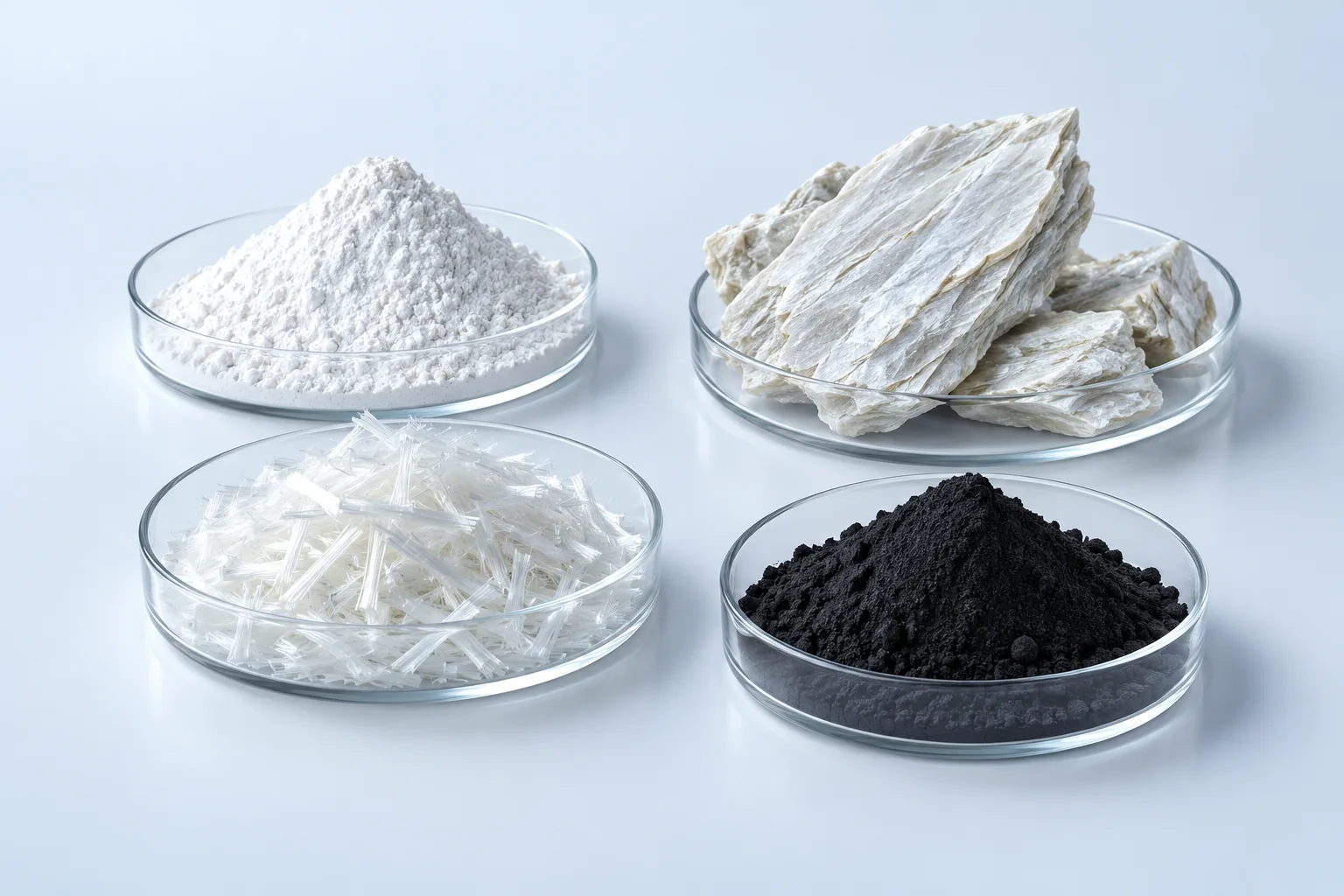
Fillers are solid materials added to polymers to modify mechanical properties, control dimensional behavior, adjust density, improve certain functional characteristics or optimize formulation cost.
Their effect depends on particle size and shape, surface chemistry, dispersion, loading level and interaction with the polymer matrix. Some fillers mainly reduce cost, while others provide reinforcement or functional benefits.
An economical and widely used mineral filler.
Can improve stiffness and dimensional stability in suitable thermoplastics.
Reinforces the material and increases stiffness and strength.
Used for reinforcement, rheology modification and other functional purposes.
Coloration, UV protection and electrical functionality in selected formulations.
Can improve stiffness and dimensional stability in suitable systems.
Flame-retardant mineral fillers in suitable formulations.
Plastic compounds, rubber products, cables, construction materials, automotive components, coatings, adhesives and sealants.
Technical guidance on filler selection, particle characteristics, surface treatment, dispersion, loading level and compatibility with the polymer matrix.